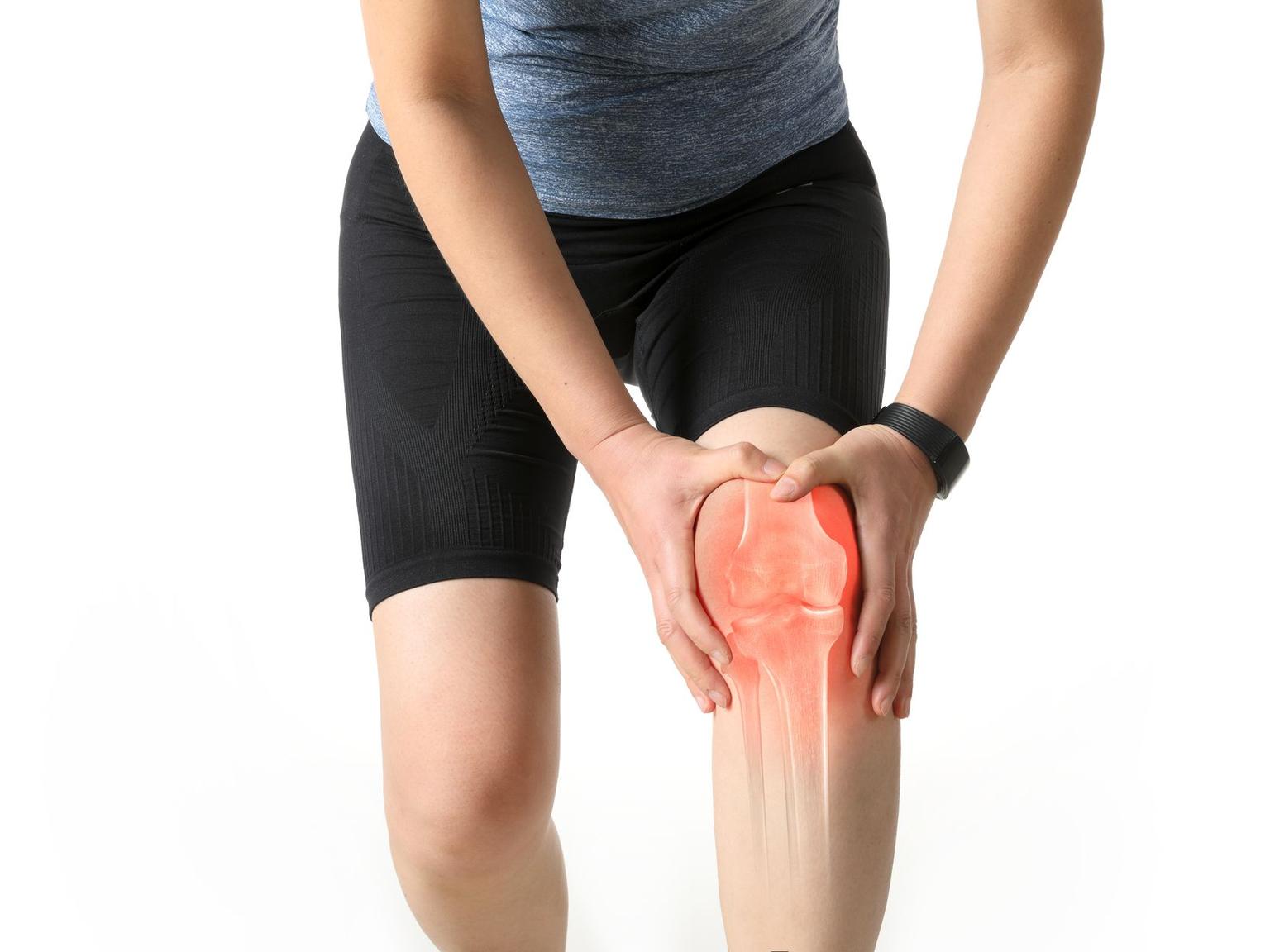
Knee osteoarthritis (also known as gonarthrosis) refers to the wear and tear of the cartilage layer of the knee joint. The cartilage serves to reduce shock during load. In the advanced stage of gonarthrosis, this is largely degenerated. "Holes" form in the cartilage layer. Unlike cartilage, bone is sensitive to pressure. When the cartilage is worn out, it leads to painful bone-to-bone contact of the knee joint surfaces. Gonarthrosis is a degenerative condition whose frequency increases non-linearly with age. Women are significantly more affected than men.
The main risk factors include being overweight, heavy loads in daily life (intense sports or manual labor), misalignments of the legs and/or dysfunctions of the foot (flatfoot) or knee (strong internal or external rotation of the thigh or lower leg). Previous injuries and surgeries of the knee, especially of the menisci, also increase the risk of developing early gonarthrosis. Typical signs of beginning gonarthrosis are starting pain, movement restrictions, and thickening or swelling of the joint.
Gonarthrosis and Misalignments
In an American study population of nearly 2600 people, over 50% of men and almost a third of women had a varus alignment (bow-legged), while one in four women and only one in ten men had a valgus alignment (knock-kneed) of the knee. The leg axes were determined using standing X-rays. The more common bow-legged position increases the load on the medial knee compartment and is one of the primary reasons for the development of medial gonarthrosis. A valgus alignment of the knee, on the other hand, tends to increase the load on the lateral knee compartment, thus posing an increased risk for lateral gonarthrosis. In the aforementioned study population, medial gonarthrosis is significantly more common, regardless of race and gender.
In some cases, we unexpectedly observe that a medial gonarthrosis develops with a valgus alignment, which may seem incomprehensible at first. Here, the compensatory movement of the leg must be observed. To control/compensate for the knock-kneed position and/or foot pronation, the body aligns the toe of the standing leg inward, so that in the push-off phase, the thigh can rotate outward. This outward rotation movement of the thigh results in increased rotation and load on the medial knee compartment. This leads to early wear of the cartilage on the medial side of the knee.
How Can NUMO Help with My Gonarthrosis?
The general idea is spread that with knee or hip osteoarthritis, the impact on the joints should be reduced to protect the joint. Therefore, soft sole material is often recommended as the first measure. However, with soft sole material, there is a great risk of foot instability. In cases of misalignments, soft sole material exacerbates the existing problem. Therefore, one should primarily focus on stabilizing the axes with hard sole material. This can be reliably identified with a Gait or running analysis .
With orthopedic insoles , the knee alignment can be stabilized/controlled and the pressure distribution in the knee can be altered. For example, in a varus alignment, the pressure on the medial compartment can be reduced by raising the lateral edge of a shoe insole, thus slowing the progression of medial gonarthrosis. The influence of such insoles on knee joint forces has been studied in various studies by the University Hospital of Lausanne (CHUV) in collaboration with NUMO. A flatfoot, on the other hand, can be a cause of a valgus alignment, where suitable insoles can support the longitudinal arch of the foot and reduce the resulting valgus alignment.
Preventive and acute measures
An axis misalignment worsens over time if the stabilizing ligaments of the knee joint are affected. If there is a misalignment of the leg axis at a young age, knee osteoarthritis can develop unnoticed early on. Therefore, the leg axis should be regularly checked in children and adolescents. As long as the growth plates are open, the growth of the leg axes can be influenced/corrected.
After growth has ended, only the function/movement of the leg can be influenced. As long as an axis misalignment is not too prominent, an insole can, in most cases, additionally support biomechanics. If gonarthrosis already exists, orthopedic aids such as knee braces provide an additional treatment option. Such a brace reduces the load on the knee and stimulates the metabolism in the joint. Pain caused by osteoarthritis can thus be alleviated.
References
Marien Kliniken, "Gonarthrosis," [Online]. Available: https://www.marien-kliniken.de/kliniken-institute/klinik-fuer-orthopaedie-unfall-handchirurgie-und-sportverletzungen/sektionen/endoprothetik-kuenstlicher-gelenkersatz-und-wechseloperationen/krankheitsbilder/gonarthrose-kniegelenkverschleiss. [Accessed October 4, 2023].
S. Mariacher, C. Chmiel and U. Beise, "Arthrosis," mediX, [Online]. Available: https://www.medix.ch/wissen/guidelines/arthrose/. [Accessed October 4, 2023].
B. L. Wise, J. Niu, M. Yang, N. E. Lane, W. Harvey, D. T. Felson, J. Hietpas, M. Nevitt, L. Sharma, J. Torner, C. E. Lewis and Y. Zhang, "Patterns of compartment involvement in tibiofemoral osteoarthritis in men and women and in whites and African Americans," Arthritis Care Research, No. 64, pp. 847-852, May 25, 2012.
R. Liebscher-Bracht, "Knee joint osteoarthritis - Ways to pain relief in gonarthrosis," Liebscher & Bracht, [Online]. Available: https://www.liebscher-bracht.com/schmerzlexikon/gonarthrose-kniegelenksarthrose/. [Accessed October 4, 2023].
A. Fischer, B. Ulrich, L. Hoffmann, B. Jolles and J. Favre, "Effect of lateral wedge length on ambulatory knee kinetics," Gait & posture, No. 63, p. 114–118.
B. Ulrich, L. Hoffmann, B. M. Jolles and J. Favre, "Changes in ambulatory knee adduction moment with lateral wedge insoles differ with respect to the natural foot progression angle," Journal of biomechanics, April 16, 2020.
G. Jaques, B. Ulrich, L. Hoffmann, B. M. Jolles and J. Favre, "Walking with Different Insoles Changes Lower-Limb Biomechanics Globally in Patients with Medial Knee Osteoarthritis," Journal of clinical medicine, 2016.