Especially in winter, many athletes train indoors and/or in fitness centers. And if you don't have indoor sports shoes yet, you buy a pair. But what should you pay attention to when buying new ones? What are the differences between outdoor and indoor shoes, and what features make the perfect indoor shoe?
What is the difference between indoor shoes and outdoor training shoes?
For running shoes, many criteria are important: On one hand, the size and weight of the person running, on the other hand, the surface on which they primarily train. Running shoes are therefore cushioned very differently and have thick, almost inflated, soft soles to absorb as much impact as possible when jogging or running.
Indoor shoes differ particularly in sole hardness: They are always relatively hard. Desired is as direct a ground contact as possible and a good grip, both on the ground and in the shoe itself. The supportive stability is especially important for quick changes of direction and lateral movements. While running and jogging are straightforward and repetitive, indoor sports like floorball, handball, or basketball require frequent, changing maneuvers.
By the way: Indoor sports shoes are also suitable for fitness centers. Those who do HIIT training or strength training look for good ground grip. Calmer sports like yoga, Pilates, and individual exercises are very comfortable barefoot or in socks.
What injuries can the right indoor shoes prevent?
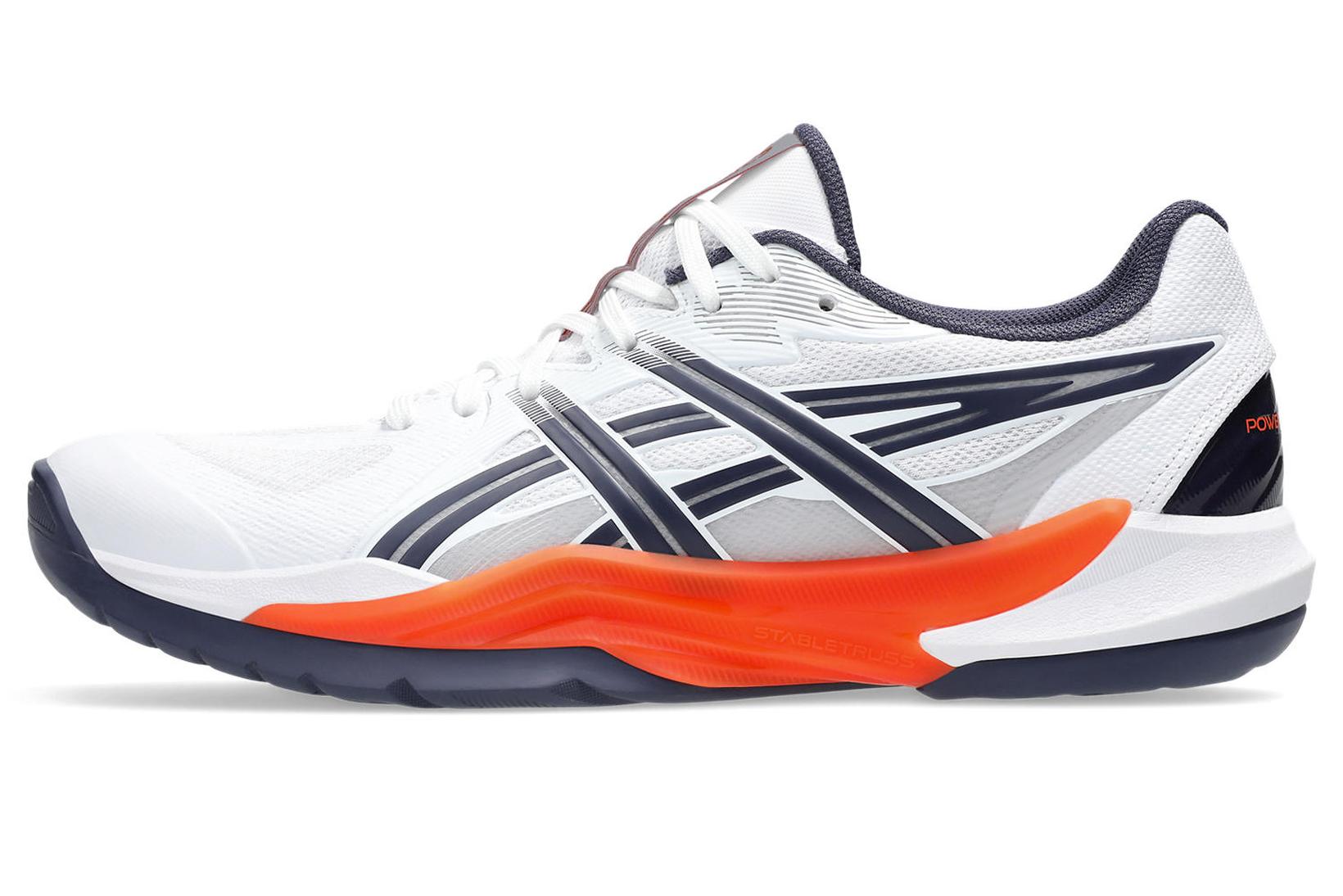
In indoor sports, the so-called supination trauma, commonly known as twisting or spraining, often occurs. Therefore, the transitions from the sole to the shoe are often reinforced in indoor sports shoes. This is visible on the outer sides of a pair of shoes, for example, the orange-colored part of this Asics POWERBREAK™ FF:
What should be considered when choosing the right indoor shoes?
Compared to running shoes, there is not much that can go wrong with indoor sports shoes. However, 3 criteria help in choosing the optimal shoe:
- The midsole or insole should be relatively hard.
- The shoe's fit around the heel, i.e., the heel cap, should provide stability.
- Indoor shoes have high torsional stability: If you grab an indoor shoe at the front and back and twist it along the longitudinal axis in opposite directions, it should remain as stiff as possible and not twist completely like a ballet shoe or climbing shoe.
Can I use the same indoor shoe for every indoor sport?
Basically, yes. However, there are indeed sports that require very specific footwear. For example, indoor soccer. These shoes have very flat soles and little upper material to imitate a natural, barefoot-like ball feel. Dance or ballet shoes, as well as climbing shoes, are also specifically designed for the respective sport.
How can NUMO assist in choosing the right indoor shoes?
NUMO checks whether the current shoe fits and whether the biomechanics are correct. If not, NUMO can assist in choosing suitable shoes or Orthopedic insoles if necessary and helpful.
Note: Shoes cannot be purchased at NUMO. After a Sports shoe consultation , you can order the suitable model through us at Ochsner Sport. Thanks to our cooperation, you receive a 10% discount.
Basically:
- If you are just starting a sport or breaking in new shoes: Take it slow. Don't do too much at once, start slowly, and gradually increase the frequency and volume.
- The shoe size must fit.
- Functionality takes precedence over design or personal color preferences.