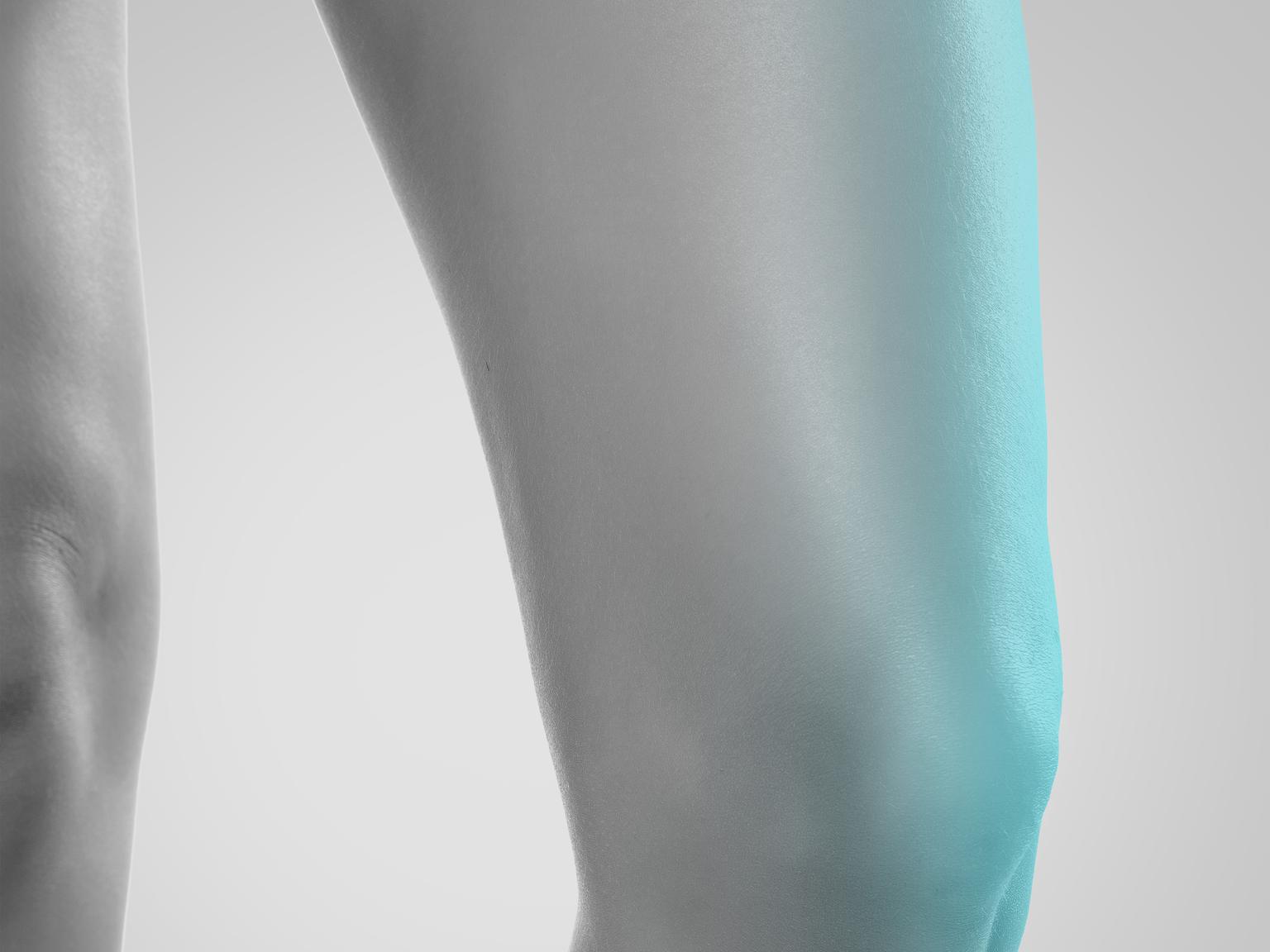
The name already suggests it: Runner's knee is a condition that mostly occurs in people who engage in running sports. Runner's knee is also called iliotibial band syndrome (ITBS). Typical for runner's knee are sharp pains on the outside of the knee, which often occur while jogging. If ITBS is advanced, such complaints can also occur in a resting state.
What are the causes of runner's knee?
Contrary to the name, the cause of the pain does not lie at or in the knee. Usually, hip movement, asymmetry, leg axis stability, or foot position are among the reasons that cause the complaints. These include, for example, excessive lateral pelvic tilt, asymmetries in the pelvic area, an unstable leg axis, excessive inward rolling of the feet, an inwardly rotated gait pattern (when the toes point inward), or a cross-step width.
The pain in runner's knee itself is caused by irritation of the iliotibial tract. The iliotibial tract (IT) is a broad structure of connective tissue on the outside of the thigh. It extends from the anterior superior iliac spine (a protrusion on the iliac crest) over the hip and knee joint and attaches to the upper outer head of the tibia (lateral condyle of the tibia). The tendon fibers or fasciae of the gluteal muscles (gluteus maximus and medius) and the tensor fasciae latae muscle insert into the IT.
The iliotibial band can also cause complaints on the side of the hip. This is typically referred to as IT band syndrome, or ITBS.
What can be done about runner's knee?
As an acute measure, it is advisable to reduce the running workload, cool the painful area, and possibly treat it with anti-inflammatory medication. Alternative training can be switched to (for example, in water or on a bicycle). If the IT is worked on with a foam roller, care should be taken not to roll over the knee joint.
Why a running analysis is important for runner's knee
The causes of runner's knee involve a complex movement chain. Therefore, it is very important to precisely determine where the problem lies. A Running Analysis is the solution here. It is essential that the pelvic movement is also examined. Accordingly, targeted exercises (stabilization exercises, running technique) and possibly orthopedic measures, such as Shoe Insoles , must be taken. The Correct Shoe Choice can also provide relief for some problems.
NUMO helps with runner's knee
In a detailed running and gait analysis, we get to the bottom of the complaints. As measures, we also recommend the Running Seminar , which we will conduct in collaboration with Michaela Imhof from Run Better.