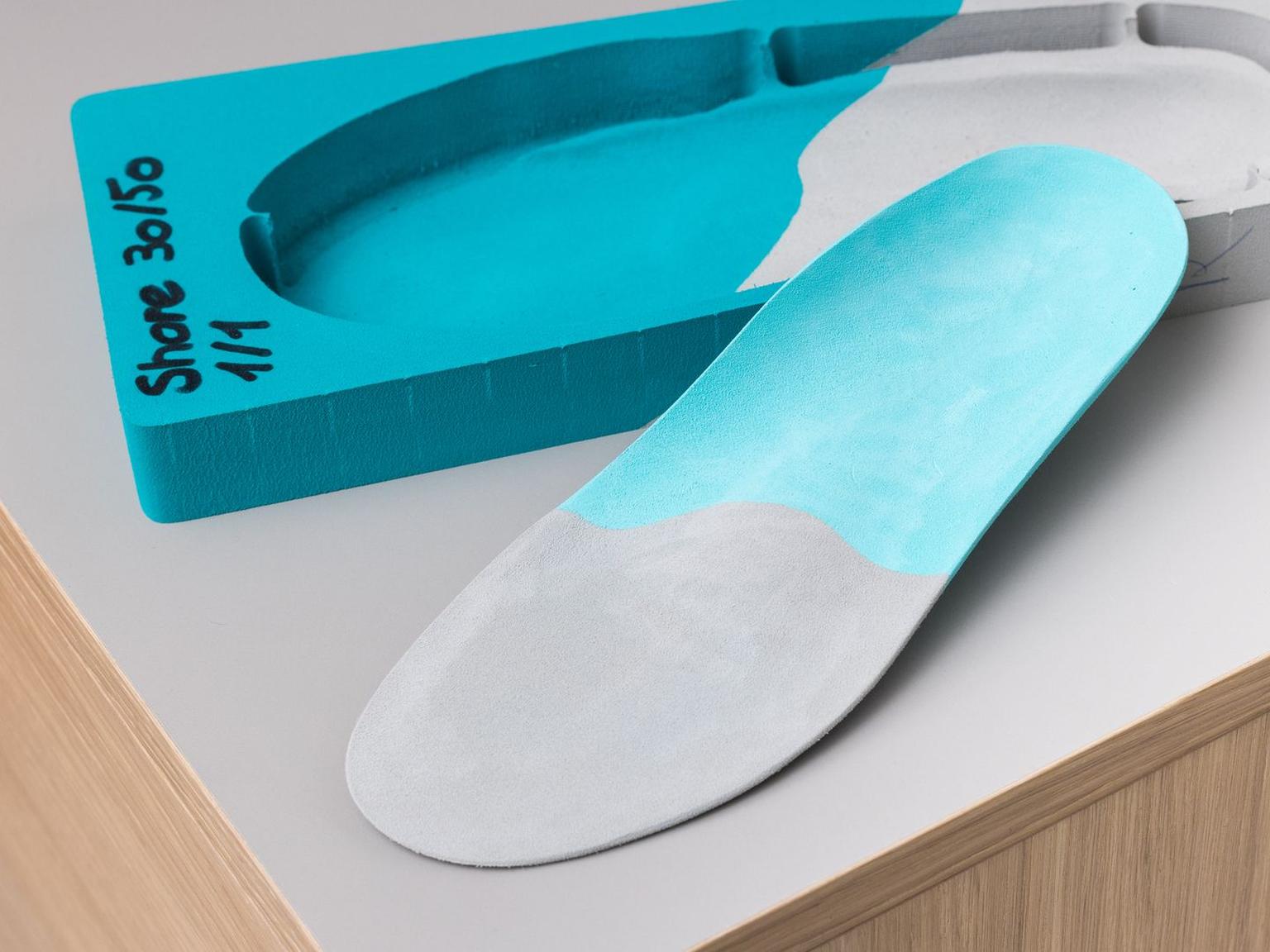
Looking into the specialist literature – or at a typical doctor's prescription – an orthopedic insole works in two directions: it supports the longitudinal arch and the transverse arch of the foot. These two elements are the central components of an orthopedic insole. However, its corrective potential is much greater than one might think.
Amplified by the lever effect
The reason for this is the lever effect known from mechanics: It ensures that a correction on the foot is amplified many times over – namely via the lever of the lower leg, thigh, hip, and spine. In practice, this means: With a corrective element on the foot of just one millimeter, several centimeters of displacement can be generated on the spine.
Scientific studies have also found that forces sent upwards have a stronger effect than their opposite. This means a correction on the foot has more influence on the pelvis than a correction of the pelvis on the foot. Accordingly, a misalignment of the pelvis is easier to correct with insoles than a misalignment of the foot itself.
Effect when standing and walking
The support of the longitudinal arch mainly affects the stance phase – when the foot is flat on the ground. During a step, however, the stance phase only accounts for 40 percent of the foot's load time on the ground. The push-off phase is the longest phase of the step, accounting for 50 percent of the load time.
Thanks to the advancement of biomechanics, new corrective elements have been developed in the forefoot that have not yet been described in the classical literature of orthopedic technology. The corrective elements described so far are mostly located in the retrocapital area – that is, behind the forefoot/metatarsus joint. In sports, the load time of the forefoot is at least 70 percent of ground contact (running). In tennis, it is more than 90 percent of ground contact.
Corrections for All Three Phases
Unfortunately, corrective elements in the subcapital area – that is, under the forefoot/metatarsus joint – are often neglected because they take up some space in the shoe. However, these elements have a significant impact on the entire body: they are essential for optimal power transmission, as they help correct misalignments throughout the entire step – not just during the stance phase. A modern orthopedic insole should therefore provide corrections for all three phases: landing, stance, and push-off phase.
Asymmetric Insoles Have an Advantage
Mirrored insoles are unfortunately still the standard in insole supply. However, our body is not symmetrical. Most sports are also asymmetrical. Even in jogging or cycling, which are considered symmetrical sports, our long-standing experience in gait and running analysis shows that the left leg has a different gait pattern than the right leg.
As a result, many injuries or complaints are unilateral. Asymmetric orthopedic insoles should therefore definitely become the norm. The impact of a correction in the diagonal, that is, on the opposite side, should also not be underestimated.
How a Corrective Element Works
Next, let's look at the different corrective elements. Various techniques can be applied: The mechanical element primarily exerts mechanical pressure on the bone structure. By altering the force on a bone, combined with mechanical leverage, a misalignment is corrected.
The muscle must then adapt to the new pattern. The thicker the element, the stronger the mechanical effect. Advantage: The effect is immediate when the insoles are worn. Disadvantage: More space is needed in the shoe – especially for corrections in the forefoot.
Proprioceptive Insoles
This type of insole features a proprioceptive area: This is a 1.5-millimeter-thick element that is specifically placed on the foot to generate tension or relaxation of the muscle chains. It works like a stone in the shoe. The stone causes a slight disturbance. My foot tries to avoid the stone and activates other muscle chains that influence the gait pattern.
The elements are placed so that the effect is comfortable. Advantage: The insoles require very little space in the shoe and have a very good impact on muscular complaints/imbalances. A noticeable effect is also evident over short distances/loads. Disadvantage: The insoles are not strong enough for bone misalignments. Their effect diminishes as the muscle becomes fatigued. Modern insoles usually combine both corrective elements: mechanical and proprioceptive elements.
Annual Follow-ups for Insoles
Last but not least, orthopedic insoles are an evolving form of therapy. This means that with each new corrective element, the body adapts to the new mechanical demands. Therefore, follow-ups and adjustments of the orthopedic insoles are necessary. NUMO therefore recommends an annual check-up of the gait pattern and insoles.